|


GTIN
Colloquially, many know GTIN as a barcode, but technically, GTIN is the number found beneath the barcode symbol itself, and can therefore also be used for other technologies such as 2D barcodes and RFID tags.
Colloquially, many know GTIN as a barcode, but technically, GTIN is the number found beneath the barcode symbol itself, and can therefore also be used for other technologies such as 2D barcodes and RFID tags.
The traditional 1D barcode - such as the EAN-13 barcode you know from retail products - has for decades made it possible to identify goods quickly and uniquely.
With 2D barcodes the barcode can hold more information and be used for more purposes.
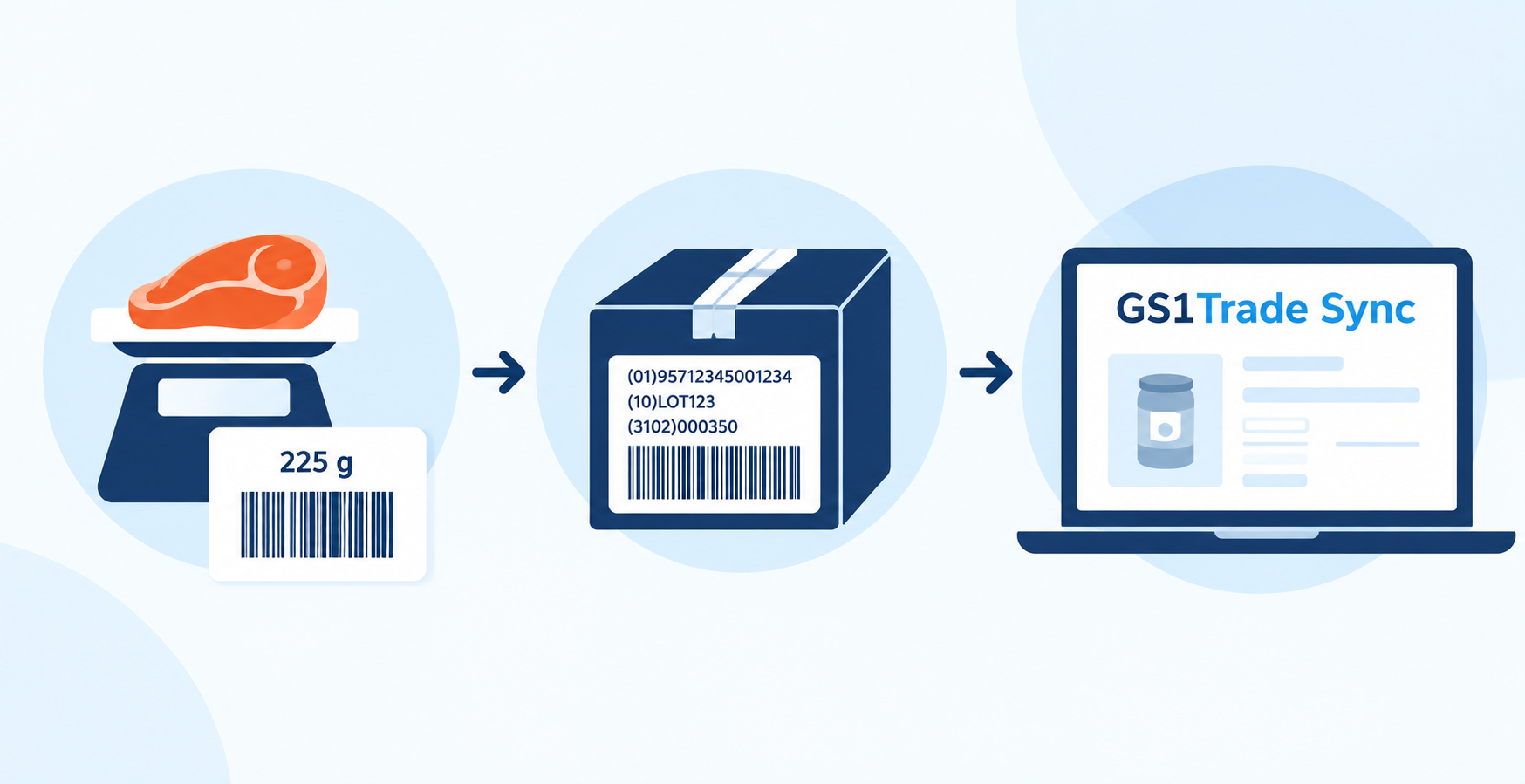
A GTIN can, for example, be combined with a batch number, best-before date, and/or serial number. With GS1 Digital Link the product's identification can also be connected to online information.
This provides new opportunities for consumers, businesses, and trading partners alike.
A 2D barcode stores information both horizontally and vertically. Unlike a traditional 1D barcode, a 2D barcode can therefore hold more information - such as a GTIN, batch number, expiration date, and/or serial number.
GS1 Digital Link is a standard that makes it possible to connect a product's GS1 identification - typically its GTIN - with digital information via a web address.
A simplified GS1 Digital Link might look like this:
https://id.eksempel.dk/01/05712345678903
Here, /01/indicates that the following digits are the product's GTIN.
When GS1 Digital Link is encoded into a 2D barcode, the product's physical identification can also become the gateway to digital information.
→ Read: How to create a GS1 Digital Link
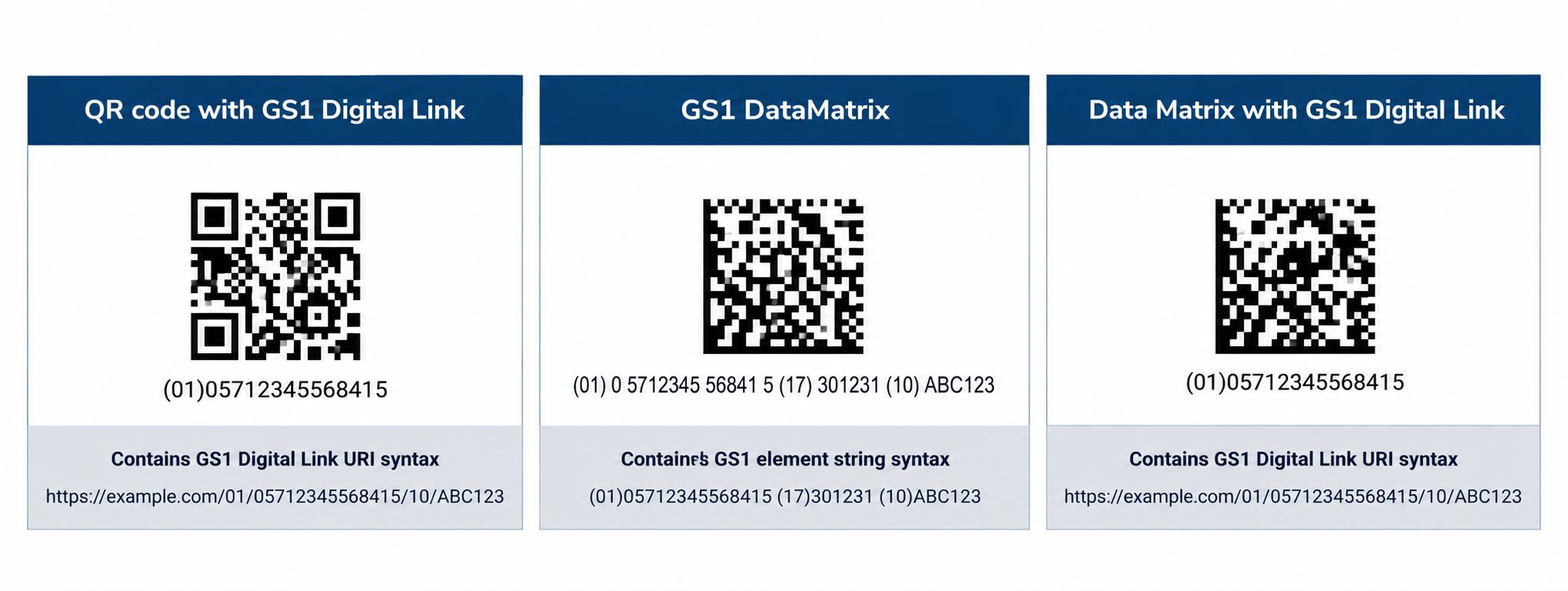
There are several types of 2D barcodes, but in a GS1 context, these three are particularly relevant:
Relevant when the product needs to be identified while also providing access to digital information. The QR code can be scanned using the camera on standard smartphones.
Relevant when, for example, GTIN, batch number, expiration date, and/or serial number need to be read by a scanner and registered directly into an IT system – such as in production, in the warehouse, or for other processes in the supply chain, the healthcare sector, or retail.
Like the QR code, it contains a GS1 Digital Link and can therefore provide access to digital information. Currently, however, standard smartphone cameras cannot scan a Data Matrix with GS1 Digital Link in the same way they can a QR code with GS1 Digital Link.
→ Read: Should I use a QR code with GS1 Digital Link or a GS1 DataMatrix?
Depending on your needs, 2D barcodes can, for example, help you to:
Ask first: What do we want to achieve?
Does the consumer need access to digital information? Should batch and expiry dates be registered upon scanning? Do you need to support traceability or documentation?
The purpose determines what information the barcode should contain and which type of 2D barcode suits your needs.
Need to choose a 2D barcode type?
→ Read the guide: Should I use a QR code with GS1 Digital Link or a GS1 DataMatrix?
Are you ready for implementation?
→ Read the guide: How to transition from 1D barcodes to 2D barcodes
Do you still need help? Reach out to our support team. We are always ready to help.