The Global Language of Business
Contact ushvidt omrids af cirkel med hvid pil i midten der peger mod venstre

What are Digital Product Passports?

A Digital Product Passport (also called DPP) is a set of sustainability data associated with physical products. It can be built through GS1 standards, among others, and allows you to verify, manage and make the sustainability of your product visible in practice.

The purpose of the digital product passport is to enable and highlight circular products and business models and to promote more sustainable consumption.

This allows each product to be uniquely identified and digitally linked to one or more data sources with information about the individual product.

Kvinde i beige jakke scanner prisetiket på rød bluse med telefon i en butik.

Understanding Digital Product Passports
in two minutes

Digital Product Passports help us repair, reuse and recycle our products, making better use of our raw materials and protecting the environment.

Discover how GS1 standards help you implement digital product passports.

Digital Product Passports in practice

Digital Product Passports outline circular products and business models. The product passport thus assigns a unique identity to the product, which is linked to one or more data sources.

It gives businesses and consumers easy access to product information such as durability, origin, warranty, recycling and instructions for assembly or repairs directly from the supplier, or other data sources chosen by the supplier.
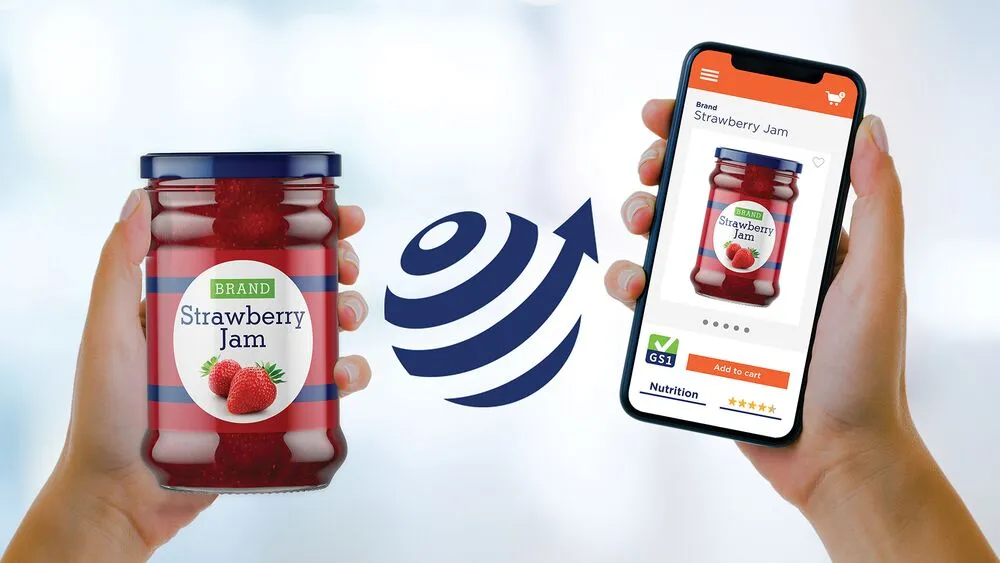

Hånd, der holder et glas jordbærsyltetøj med et digitalt icon imellem mod en hånd med en smartphone, der viser det samme glas og en online butiksside.
Mand med orange trøje, der samler et rundt træbord i en bolig.

The new EU legislation

Europe is at the beginning of its transformation to a more circular economy and aims to become the world's most sustainable region. Digital product passports are included in a new EU legislative framework - the Ecodesign for Sustainable Products Regulation (ESPR), as part of the EU Green Deal, with the aim of fulfilling Europe's commitment to the Paris Agreement and the UN Sustainable Development Goals.

The proposal covers virtually all physical products on the European market in all product areas with the exception of food, animal feed and medical products, where other legislation with similar requirements applies. The law was voted through in April 2024 and journalized in July of the same year, after which the rules will be rolled out gradually until 2030.

Digital Product Passports for Car Batteries

Digital product passports have already been introduced for automotive and industrial batteries. Watch the short video for a concrete example of how it works in practice.

Benefits of Digital Product Passports

Et produkt med informationer ved siden af samt et stregkodenummer under

Contributing to sustainability

Consumers receive product data via their smartphone to support their sustainable choices.

Ring i midten med ikon af menneske og fem andre ringe udenom der er forbundet med linjer

Increased traceability

Unique identities and standardized data make it visible that all parties in the value chain meet sustainability requirements.

Telefon med billede af flaske på og et forstørrelsesglas der undersøger telefonen

More transparency

Open sustainability data provides greater international visibility for businesses and consumers through the supply chain.

Pilleglas-ikon med pil ved siden af der peger på ikon af et menneske

Consumer and product safety

Reliable and verified data protects products, consumers and patients and ensures that everyone gets the same information.

Produkt med 2D stregkode og fartstriber efter

Efficient logistics flow

Buyers and producing companies avoid unnecessary manual administration and handling of data.

Et a4 ark med et kvalitetsstempel på som et diplom

Law enforcement

Standardized information ensures that companies comply with laws, regulations and industry requirements.

Digital Product Passports and GS1

GS1 standards enable digital product passports to work in practice. Especially standards for identification, labeling and sharing. Including 2D barcodes and GS1 Digital Link are particularly relevant for digital product passports.

This means that GS1 standards provide online access and product information from the same barcode can be scanned by consumers with mobile phones, at the point of sale and by all parties in the supply chain.

GS1 Denmark has a driving role in enabling solutions for digital product passports. We are active in the global standardization work at GS1 to further future-proof the GS1 standards as the foundation of circular value chains.

DPP projekter

Her er et overblik over projekter og samarbejde på nationalt og europæisk niveau.

Learn more about digital product passports

Read more about the new EU regulation, Deloitte's report on the necessity of global standards in a regional circular transition and see the latest releases from GS1 in Europe - GS1's umbrella organization for the entire European region.

News from GS1

Read updates and news from home and abroad related to GS1.

Questions and answers

Below you'll find some of the questions and answers we've already received. You may find the answer you're looking for here.

Should the Digital Product Passport be on the product or the packaging?

Udvid ikon - en mørkeblå cirkel med et mørkeblåt plus indenisammenfold ikon - en mørkeblå cirkel med et mørkeblåt minus indeni

The product identifier (for example, encoded in a GS1 QR Code powered by GS1 Digital Link) must be placed on the product itself or included in documentation accompanying the product.

In most cases, the same code will also appear on the packaging. This makes it easier for consumers to access product information before making a purchase and allows the code to be scanned in-store without opening the packaging.

Which products will be covered by the legislation?

Udvid ikon - en mørkeblå cirkel med et mørkeblåt plus indenisammenfold ikon - en mørkeblå cirkel med et mørkeblåt minus indeni

The legislation will apply to all products placed on the EU market, with the exception of food, animal feed, and medicinal products.

What applies to food packaging?

Udvid ikon - en mørkeblå cirkel med et mørkeblåt plus indenisammenfold ikon - en mørkeblå cirkel med et mørkeblåt minus indeni

At present, the EU is not planning to introduce Digital Product Passports specifically for food packaging under the Ecodesign for Sustainable Products Regulation (ESPR). However, this may change as the legislation develops.

How can stakeholders access the Digital Product Passport later if the packaging is no longer available?

Udvid ikon - en mørkeblå cirkel med et mørkeblåt plus indenisammenfold ikon - en mørkeblå cirkel med et mørkeblåt minus indeni

According to the ESPR, the product identifier must be placed directly on the product using a technology that ensures it remains readable throughout the product's lifetime.

Does the legislation only apply within the EU, or also to products manufactured outside the EU?

Udvid ikon - en mørkeblå cirkel med et mørkeblåt plus indenisammenfold ikon - en mørkeblå cirkel med et mørkeblåt minus indeni

The legislation applies to all products placed on the EU market, regardless of where they are manufactured.

Do unique identifiers apply to product categories or individual items?

Udvid ikon - en mørkeblå cirkel med et mørkeblåt plus indenisammenfold ikon - en mørkeblå cirkel med et mørkeblåt minus indeni

It depends on the product category.

Products that need to be tracked and managed throughout their lifecycle will often require a unique identifier for each individual item. For consumable products, however, identification at the product or batch level is typically sufficient.

When will Digital Product Passports be introduced for other products, such as paints, chemicals, and cleaning products?

Udvid ikon - en mørkeblå cirkel med et mørkeblåt plus indenisammenfold ikon - en mørkeblå cirkel med et mørkeblåt minus indeni

The EU has not yet published a timeline for when the different product categories will be covered under the Ecodesign for Sustainable Products Regulation (ESPR).

For some product groups, such as construction products (which may include paints), other legislation is already in place requiring the disclosure of certain sustainability-related information.

Will Digital Product Passports include standards for defining product attributes, and how will consistent communication of these attributes be ensured without limiting automation?

Udvid ikon - en mørkeblå cirkel med et mørkeblåt plus indenisammenfold ikon - en mørkeblå cirkel med et mørkeblåt minus indeni

Yes. As part of the ongoing work to develop the detailed, product-specific rules under the Digital Product Passport (DPP) framework, existing standards will be assessed, and where necessary, new terminology and taxonomies will be defined and standardized for the attributes that must be included in the product passports.

This approach is intended to ensure consistent, interoperable data exchange while supporting automation across the value chain.

When will the standardization of Digital Product Passports be completed?

Udvid ikon - en mørkeblå cirkel med et mørkeblåt plus indenisammenfold ikon - en mørkeblå cirkel med et mørkeblåt minus indeni

Standardization takes time, as it involves many stakeholders and aims to create harmonized solutions that are not limited to individual industries.

The final standardization work is being carried out by the CEN/CENELEC JTC 24 working group on behalf of the European Commission and is expected to be completed by the end of 2025.

To learn more about the work of JTC 24, you can find the group's work programme here.

At the same time, GS1 is working through its Global Standards Management Process (GSMP) to ensure that GS1 standards meet the needs of our members in the transition to a circular economy, with a particular focus on Digital Product Passports. This work follows the progress of CEN and CENELEC and is also expected to be completed by the end of 2025.

How to proceed

Curious to know more about digital product passports, how to order GS1ID, get a GLN, make a barcode or similar?

You can find answers to many of the questions we receive most often from members via the button below. You are of course also welcome to contact us.