Colloquially, many know GTIN as a barcode, but technically, GTIN is the number found beneath the barcode symbol itself, and can therefore also be used for other technologies such as 2D barcodes and RFID tags.
The EU has now published the first standards for the Digital Product Passport. For companies already working with GS1 standards, such as barcodes and location numbers, this provides a head start because existing identification and data solutions can be reused as building blocks for future DPP solutions. For companies that do not use GS1 standards and want to get started with DPP now, GS1 is an ideal place to begin.
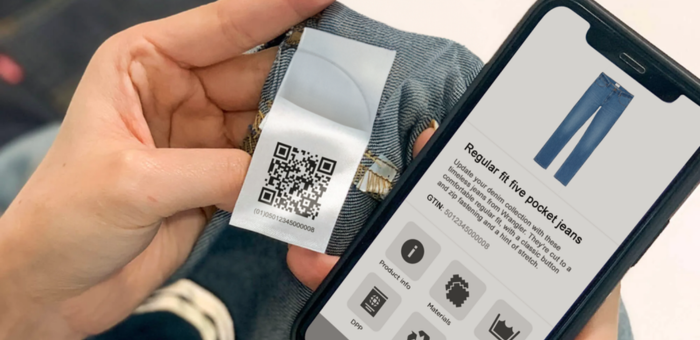
The Digital Product Passport (DPP) has moved an important step closer to reality.
Although the EU has not yet determined exactly what information the product passports must contain for individual product groups, it is now clear how they should be technically structured.
The first six European standards for DPP have just been published. The standards describe, among other things, requirements for identification, data carriers, data exchange, data storage, APIs, and interoperability.
For GS1, this publication is an important step.
Companies can, for example, use GLN, GTIN, and QR codes with GS1 Digital Link for a DPP, because they fit into the technical framework established by the EU.
The six standards do not describe which data companies must share. Instead, they describe how data must be identified, exchanged, and made accessible across systems.
This is where GS1 standards play a central role.
GTIN, GLN, and QR codes with GS1 Digital Link already support the functions required by the new European standards:
This means that companies already using GS1 standards can build on existing solutions rather than starting from scratch. And for companies that do not use GS1 standards (e.g., barcodes/GTINs), there is now a concrete and clear way to begin DPP work. The common denominator is that preparation for DPP no longer needs to wait for the final sector-specific rules.
Although the specific DPP requirements for individual product groups are still under development, one thing has become clear with the new European standards: unambiguous identification and interoperability will be the foundation of the digital product passport.
Companies can benefit from starting to:
Find a GS1 partner who can help you with DPP
Read more about how to get started with QR codes and Digital Link
If you want to know more about the six standards, you can read more below.
EN 18219:2026 – Unique Identifiers
Ensures that products, companies, and locations can be identified unambiguously.
Relevant GS1 standards: GTIN, GLN, SGTIN, and GS1 Digital Link.
EN 18220:2026 – Data Carriers
Describes requirements for data carriers such as QR codes and RFID.
Relevant GS1 standards: QR codes with GS1 Digital Link and RFID/EPC.
EN 18216:2026 – Data Exchange Protocols
Defines how data is exchanged in a structured and machine-readable format.
Relevant GS1 standards: GS1 Digital Link, GS1 Web Vocabulary, and EPCIS (Electronic Product Code Information Services)/CBV (Core Business Vocabulary).
EN 18221:2026 – Data Storage, Archiving and Data Persistence
Covers storage, archiving, and persistent access to DPP data.
Relevant GS1 standards: GDSN, Verified by GS1, and EPCIS repositories.
EN 18222:2026 – Application Programming Interfaces
Describes APIs for creating, searching, and updating product passports.
Relevant GS1 standards: GS1 Digital Link Resolver, EPCIS API, and REST/JSON-LD.
EN 18223:2026 – System Interoperability
Ensures that different systems can understand and use the same data.
Relevant GS1 standards: GS1 Digital Link, GS1 Web Vocabulary, EPCIS/CBV, and GDSN.

GS1Trade Image provides professional marketing and planogram images that meet retailers' requirements and imaging guidelines.
If you want to create your own product photos, we can also help you get certified.

GS1Trade Sync is a data pool for product data exchange that your trading partners can access.
GS1Trade Sync streamlines data exchange between trading partners because data only needs to be entered in one place. This increases the quality of product data and creates value for you - and the entire value chain.

GS1Trade Packaging is a packaging data system that gathers your packaging data in one place. The system ensures efficient collection, structuring, and declaration of packaging data, and makes it easy to exchange packaging data with other companies.

GS1Trade Exact ensures the quality of your product data. All physical products are checked against the data registered in GS1Trade Sync.
With this service, you get verified and quality-assured data that benefits the entire supply chain.

GS1Trade Transact handles the digital receipt of orders and the sending of documents to your customers. You can choose whether to integrate it with your financial system or access it online.

GTIN (also known as EAN) stands for “Global Trade Item Number” and is the number sequence shown beneath a barcode symbol.
GTIN (EAN) is a global standard used to uniquely identify digital and physical products, allowing the barcode to be scanned anywhere in the world throughout the supply chain.

A GLN (also known as EAN) allows you to uniquely identify physical, functional, legal, or digital entities. This can include the sender, receiver, buyer, seller, supplier, manufacturer, delivery location, billing location, store, or internal departments.