|


GTIN
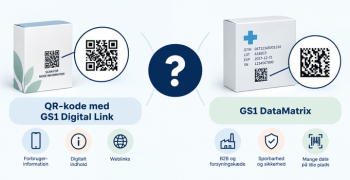
Colloquially, many know GTIN as a barcode, but technically, GTIN is the number found beneath the barcode symbol itself, and can therefore also be used for other technologies such as 2D barcodes and RFID tags.
Colloquially, many know GTIN as a barcode, but technically, GTIN is the number found beneath the barcode symbol itself, and can therefore also be used for other technologies such as 2D barcodes and RFID tags.
This guide can serve as a checklist when you build and print your shipping and package labels.
The transport industry in Denmark has collaborated with GS1 for many years to use the standards developed by the EU Commission (CEN) for marking shipments.
As senders and recipients today are increasingly dependent on Track & Trace, it is important that the ID of the shipment is unique and can be tracked from start to finish.
Cooperation between shippers and distribution centres nationally and internationally has therefore become more dependent on them being able to scan all transport and parcel labels, so that they do not have to keep track of shipments and thus do not have to do without Track & Trace.
Even at the border, unique scanning just transport and package labels are important, as it reduces processing time if the same standard has been used.
If one decides to use one's own transport or package cable system, one should be aware that there may be more disadvantages than the above points. Especially in retail, there is a requirement to use standard labeling of products and shipments, as they use the unique ID in their automated receipt of goods and in warehouses.
Attention: There can be significant financial consequences if you do not deliver products with proper labeling.
All individual consignment units shall be marked with either a transport label or a package label, whether or not Kolli that is sent alone as a parcel, a pallet, or a whole shipment, for example, a whole wagon load.
Commercial shipments are often required to have a GS1-128 pallet label containing information about the goods the shipment consists of (this will not be discussed in this guide).
If the pallet is marked with a pallet label with product information, you do not need to repeat this information on the transport label. Then it is enough to inform shipper and recipient as well as state the same SSCC number, which is indicated on the pallet label.
Private shipments (typically parcels) must have a package label containing recipient and sender information, as well as a unique package ID such as a SSCC number.
It is always the sender who prints and affixes the transport or package label to the shipment. The label can come in a file from the transport company where the pick-up has been booked, or the transport company can bring the label on pick-up and attach it to the shipment. However, it is always the shipper who is responsible for ensuring that the shipment is marked correctly.
Sender and recipient, name and address in text and unique SSCC number for automatic data capture (barcode symbol GS1-128), if the consignment is not already marked with one.
Optional options: Contact person, phone number, delivery instructions, weight in text, part number, quantity, production date, batch number or similar for automatic data capture (barcode).
Note: This is not necessarily about a GS1-128 Pallet Label as there is no receiver information on a pallet label.
Requirements: Name and address in text of sender and recipient, as well as unique SSCC number for automatic data capture (Barcode symbol GS1-128).
Optional options: Contact person, phone number, delivery instructions, weight in text, information such as postal code and order number for automatic data capture (Barcode symbol GS1-128).
Note: This is not necessarily about a GS1-128 Pallet Label as there is no receiver information on a pallet label.
A product label contains information about the product, such as barcode/part number, batch number or shelf life date - all coexpressed for automatic data capture (Barcode symbol GS1-128).
A transport or package label shall contain information about the sender and consignee and at least one unique consignment number (SSCC number) and any other transportation instructions.
SSCC stands for Serial Shipping Container Code and is a unique shipping number for a device.
In order for the sender, consignee and one or more carriers to have the opportunity to identify and retrieve relevant information in databases about the specific shipment, it is important that there are no errors in the labelling. The Shipment ID (SSCC) must be unique and assigned only to exactly this consignment on which the label is placed.
NOTE: In order to make SSCC numbers, one must subscribe to a company prefix, either a 7-digit or an 11-digit one. You can do this at GS1 Denmark if you don't already have one.
The SSCC number comprises 18 digits.
The first digit determines the sender himself (from 0-9).
The next digits are Company prefix (either 7 or 11 digits).
The next 9 digits (if one has a 7 digit prefix) or the next 5 digits (if one has an 11 digit prefix) are the serial number.
The 18th and final digit is a control digit.
NOTE: It is important that you keep track of which numbers you have used so that multiple shipments do not get the same SSCC number.


Besides that the SSCC number provides a unique number for Track & Trace, there is also the advantage of being able to indicate in your EDI invoices and delivery notes which SSCC number the consignment has. In this way, the recipient receives information about the products before they arrive, which is an advantage in the receipt of goods.
The information can also help with shipments that need to cross national borders. Here, customs information can be sent in advance, and in this way customs processing can go faster.

1. Information about the sender's name, address, city and country and any company logo shell to be completed.
2. Information about the recipient's name, address, city and country shell to be completed.
3. Transportation instructions fields no. 3 are optional, but here you can specify, for example, weight and dimensions, contact person and whether there are special access conditions.
NOTE: All information in the above 3 fields is all context.
4. In field 4, the barcode symbol is displayed (GS1-128) containing SSCC number.
NOTE: The SSCC symbol should always appear at the bottom of the block, so if you specify more information in the GS1-128 symbol, such as country and postal code, these should be above the SSCC number.
Here is used AI 403 (route id) + AI 421 (Iso country code + postal code) + AI 00 SSCC number.
Information such as route, country and postcode should also be entered in field 3 of the Transport Instructions so that the carrier can still read the information in the event that the barcode is destroyed.

401 = Shipping number 403 = Route ID.
.410 = Delivered to recipient location number (GLN).
420 = Delivered to domestic postcode (format n3 + an.. 20).
421. = Country Code (ISO) + Postal Code (format n3 + n3 +x.. 9).
See the full list of Application Identifiers
The following example is the European Commission's proposal on what a harmonised packaging label should look like in future for intra-European trade. A digital strategy has been developed “Digital Single Market” which should make it smoother especially for e-commerce to trade across borders (Cross-boarder).
Like the transport label, this label contains a sender and receiver field for name and address information in text form.
NOTE: This is mandatory to fill out.
Above the address fields, space has been made for the name and logo of the freight/postal company.
After the receiving field, there is a field for transport instructions. Here you can specify both text and other symbols such as GS1 Datamatrix or QR code. These two-dimensional symbols do not take up much space, but can contain a lot of data. In addition, it takes a lot of effort before the symbols cannot be scanned. It is choice free to fill something in the field.
In the next lower field there is room for own symbols, e.g. UPU (postal union) their own Letter of Consignment Number ID. They can put that in here. As in the previous example, you can also insert symbols with route, country code and postcode here. It is optional to fill in the field.
In the lower field indicate The SSCC symbol.
NOTE: This is required to fill out.
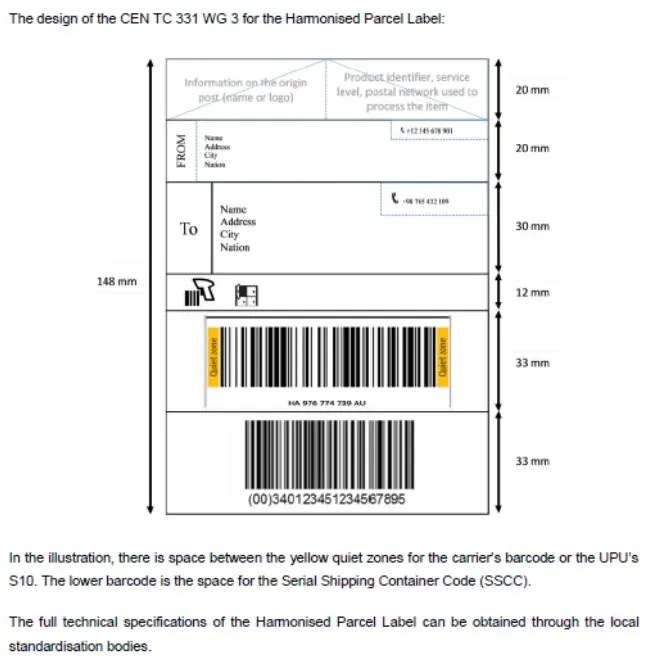
Below you can see an example of harmonized package label without extra symbols:

1. The symbol containing the SSCC number must be a GS1-128 Symbol recited BS ISO/IEC 15420:2009.
2. The height of the symbol must be 32mm high to be able to ensure readability up to 90 cm from the label.
3. The narrowest module (X) should be in the range between 0.50 unto 0.84 mm.
4. There must be a light zone before the first line and after the last line of the symbol. The light zone must be at least 10 times the width of the X module to ensure optimal scanning.
5. The barcode should be oriented standing (like a fence).
6. The data content of the barcode symbol should always be in clear text immediately below the symbol, so that the value can be entered manually if the symbol is not scannable.
1. The barcode quality must at least reach grade C according to ISO/IEC 15416:2016. Please note that it must also be able to be scanned, even if the label has been loaded on and off during the journey, exposed to weather and wind, sun and moisture.
2. Check that the print is clear — maybe the printer is running out of toner!
3. The label quality must be able to withstand the wear and tear that it will typically be subjected to during the journey from sender to receiver. Choose a material that takes into account label/paper thickness to avoid errors when scanning due to underlying material.
NOTE: The label should not change characterby light, heat/frost and moisture.
4. The label width is recommended to be 105mm and 148mm. The latter should be used when there is a need for a large amount of information on the label.
5. Label length can vary depending on how much data you have in, but should not be longer than, respectively. 200th and 250mm.
The label is placed so that there is a minimum 50mm air out to a vertical edge. This ensures that the label does not break so easily along the way. Labels for pallets should be placed on the side of the pallet so that the bottom barcode is between .400 and 800mm from the floor (not on top). For colli/packages, the label should be placed on the largest face, which will act as the top of the colli/package.
The Common European Standardisation is administered by CEN (European Committee for Normalisation).
The two labels we describe in this guide follow the requirements below:
EN 1573:2015 = Multi Industry Transport Label.
BS ISO/IEC 15420:2009 = EAN/UPC barcode specifications.
ISO/IEC 15416:2016 = Test specifications for barcodes.
TS 17073 = Technical specification for Harmonized package label.
Find more information at the GS1 organization.
Do you still need help? Reach out to our support team. We are always ready to help.