|


GTIN
Colloquially, many know GTIN as a barcode, but technically, GTIN is the number found beneath the barcode symbol itself, and can therefore also be used for other technologies such as 2D barcodes and RFID tags.
Colloquially, many know GTIN as a barcode, but technically, GTIN is the number found beneath the barcode symbol itself, and can therefore also be used for other technologies such as 2D barcodes and RFID tags.
It may happen that you have added the wrong recipient in GS1Trade Packaging.
Go to the products you want to share > select 'Share Settings'.
Have you selected the correct GLN? You can see the recipient's name and GLN under Data Recipients.
Also check that you are sharing to GS1Trade Sync. If Share to GS1Trade Sync is Active - it is correct.
Note: If you subscribe to GS1Trade Sync, you can't select recipients in GS1Trade Packaging. Disregard this.

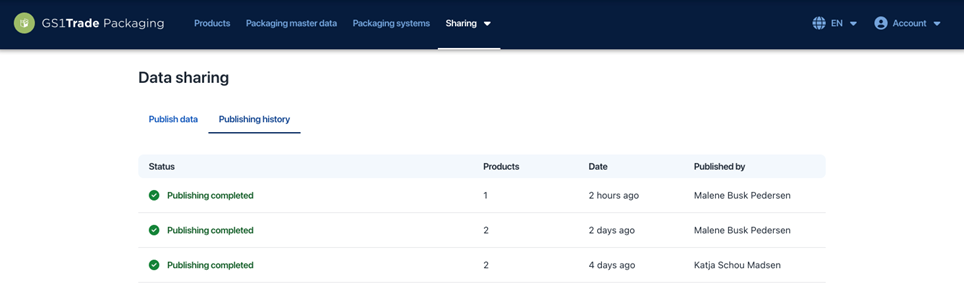
Go to Sharing > Publications and see your history. Can you see your publication here?
If you can't see your publication here, go to Publish data.
Select the products and click Publish to share. Go back to Publications and check that the publication is completed.
Go to GS1Trade Sync and search for the GTINs you want to share. Check whether your GTINs already exist in GS1Trade Sync and have the status Live or Published. Your packaging data will be linked to your GTIN. You don't have to do anything further.
If your GTINs are shown as Draft, add a recipient and click Publish.
The errors are displayed directly in the Product overview next to the affected product. When you see an orange exclamation mark next to the product name, it indicates that errors need to be addressed.
The number shown on the icon indicates how many types of errors the product contains.

Do your customers still not see your data? Contact GS1 Denmark.
Do you still need help? Reach out to our support team. We are always ready to help.