

8 min.
2.10.2025
GS1 standards help locate staff and create peace of mind
Text
Karen Gahrn
Photo:
Central Denmark Region
It has created a calmer working environment, as you can see, for example, if a colleague is busy with patient care. The system, which uses GS1 standards, is now a fully integrated part of everyday life at the department.
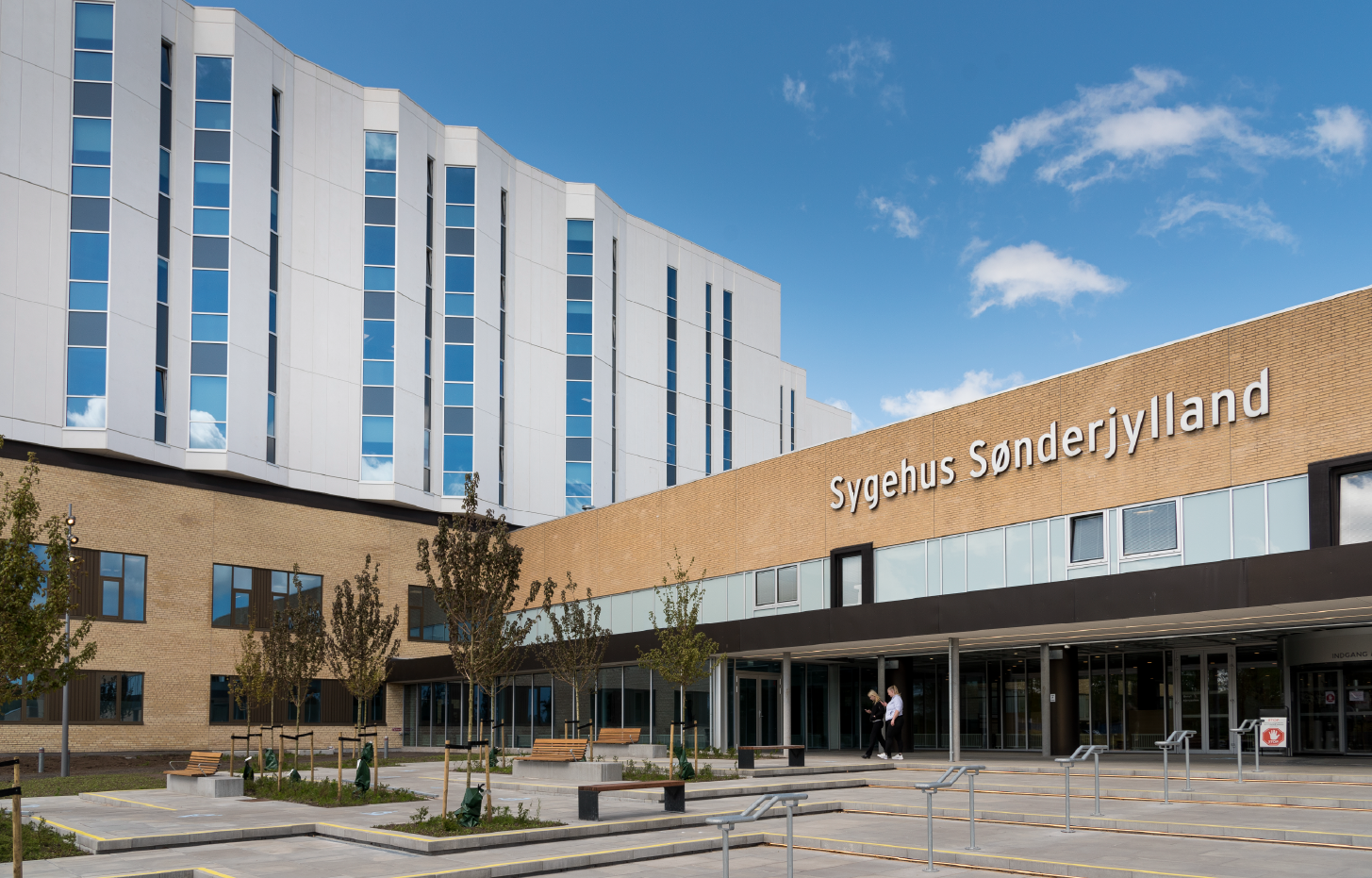
Aarhus University Hospital in Skejby is equipped with nearly 7,500 antennas, and around 25,000 RFID tags are placed on a wide range of hospital items such as beds and medical equipment. This makes it possible to know where things are at any given time.
The Department of Elderly Diseases has taken localization a step further. As the only hospital department in the country, they have equipped all staff with an ID card containing a chip that also makes it possible to see where they are at any given time. The common 'language' that makes it possible to share and use this information is GS1 standards, which play a central role in ensuring better processes for the department's staff.
Nurse Marie Nielsen has been involved from the start, when the department began working with staff localization:
– In the beginning, there was talk of surveillance, things like: 'Can you see when I'm in the restroom?'. But you can't. So that quickly passed, because that's not how we use the system. We use it to strengthen collaboration and patient safety. And we have found that localization leads to fewer interruptions and less unrest, she says.
– If I need a colleague but can see she is in a room with a patient, I just wait until she comes out.
Peter Krogh Brynningsen is a consultant at the department:
– I can easily get called many times during a day. We work a lot in the department on eliminating unnecessary interruptions, and the localization system helps with this. For example, we have patient consultations where we bring together patients, relatives, and the interdisciplinary team. Here, it is important, both for us and for the patients, to reduce unnecessary interruptions. Now, the rest of the staff can see that I am in a consultation room, he says.
– I might also need a conversation with a nurse before a patient is discharged, and before I send a message, I just check. This means it works both ways; it's also a matter of not interrupting the nurses in their work.
Pia Serwin is a medical secretary at the Department of Elderly Diseases:
– I quickly discovered that it is a really good system. I sit with the coordinator, so I use the system on the computer and can quickly check where someone is instead of calling or perhaps having to go out and look for them. So it saves time in our daily work.


In the beginning, there was talk of surveillance, things like: 'Can you see when I'm in the restroom?'. But you can't. So that quickly passed, because that's not how we use the system. We use it to strengthen collaboration and patient safety. And we have found that localization leads to fewer interruptions and less unrest.
GS1 has given us a common language
Claus Bugge is a product manager and project leader in the Central Denmark Region's central IT organization and is, among other things, responsible for the localization systems.
Staff is a limited resource, and it is no secret that both doctors and nurses are busy. So, having invested in all these antennas, we looked at how we could create value by not just locating items, but also locating people. It is about creating better collaboration, better communication, better capacity management, and giving different professional groups the ability to see where their colleagues are, says Claus Bugge.
From the start, our task was to look at how we could use technology that is already widely used in sectors like retail, which has a great need to keep track of where goods are. How could hospitals benefit from that technology? We had the hardware technology, we had software systems developed by suppliers, and we have had close cooperation with GS1 on standards along the way, he explains.
For Claus Bugge, GS1 has been a new partner.
I have been surprised by how committed GS1 has been to how their standards create value in the healthcare sector. They are not driven by selling IT systems to hospitals, but I have experienced that they have a great interest in how their standards are used. We have had a very good collaboration, and I have visited GS1 in Copenhagen several times.
Claus Bugge has found GS1’s standards to be a solid foundation for the entire localization system.
We have been able to tell our software suppliers: 'You must comply with these standards.' If we didn't have the standards, it would have been more chaotic, and our software suppliers would likely have set the agenda to a greater extent. Now, we rely on a common language that GS1 has provided us.
Time savings, peace of mind, and patient safety
The Department of Geriatric Medicine itself chose to embrace the future when moving into the new hospital in the spring of 2017 by using the new technology to also locate staff.
Now, we are systematically examining the value the system has created for the department. We can only improve the system in collaboration with the users, and therefore their feedback is indispensable, says Claus Bugge.
For medical secretary Pia Serwin, time savings is the biggest advantage:
I can see that Peter is right there and quickly decide whether I can call him or if it is better to wait, she says.
Consultant Peter Krogh Brynningsen has no doubt about the benefits for everyone in the department:
It provides a better working environment and better quality when we can reduce unnecessary interruptions. When I find that I am called by our coordinator or a secretary when I am out of the room instead of during a conversation, I think: 'Thank you so much for that.' It is important for both me and the patient, he says.
Nurse Marie Nielsen agrees:
We have a patient group that is easily disturbed by, for example, a phone call. An admission can be confusing enough as it is, so providing as much peace as possible is important, especially for elderly patients.
We clearly work most efficiently if we have the opportunity to finish the task we are working on before moving on to something else. Reducing interruptions means a lot for my working environment, but it also means something for patient safety, says the consultant.
During the pandemic, we had many isolation rooms, and it became even more important that we didn't have to open a lot of doors to look for someone. Localization meant a lot there; it provided much better safety. And we still have isolation rooms for corona or influenza patients.

Staff localization is based on GS1 standards
Electronic Product Code Information Services (EPCIS) is the GS1 standard used for capturing and sharing event data across systems. The standard creates transparency and makes it possible to answer the questions: what, when, where, why, and how.
For the system to function, all units must be identified with GS1 numbers – for example, GTIN for equipment and GLN for locations. RFID/EPC tags act as physical information carriers that can be scanned and contain the GS1 numbers that identify objects or people.
When it comes to staff localization, each employee chip has a unique code (EPC or tag ID). In the region's systems, this code is linked to a person identifier (GSRN), which is the GS1 standard for identifying service relationships.
This makes it possible to show that nurse NN is in room X, where the location is based on GS1’s GLN.
Staff information is not stored
Staff at the Department of Geriatric Medicine have a chip attached to the ID badge that everyone uses for tasks such as opening doors. Each chip has a unique ID, and every time the employee enters a new room, the antenna in that room detects their presence.
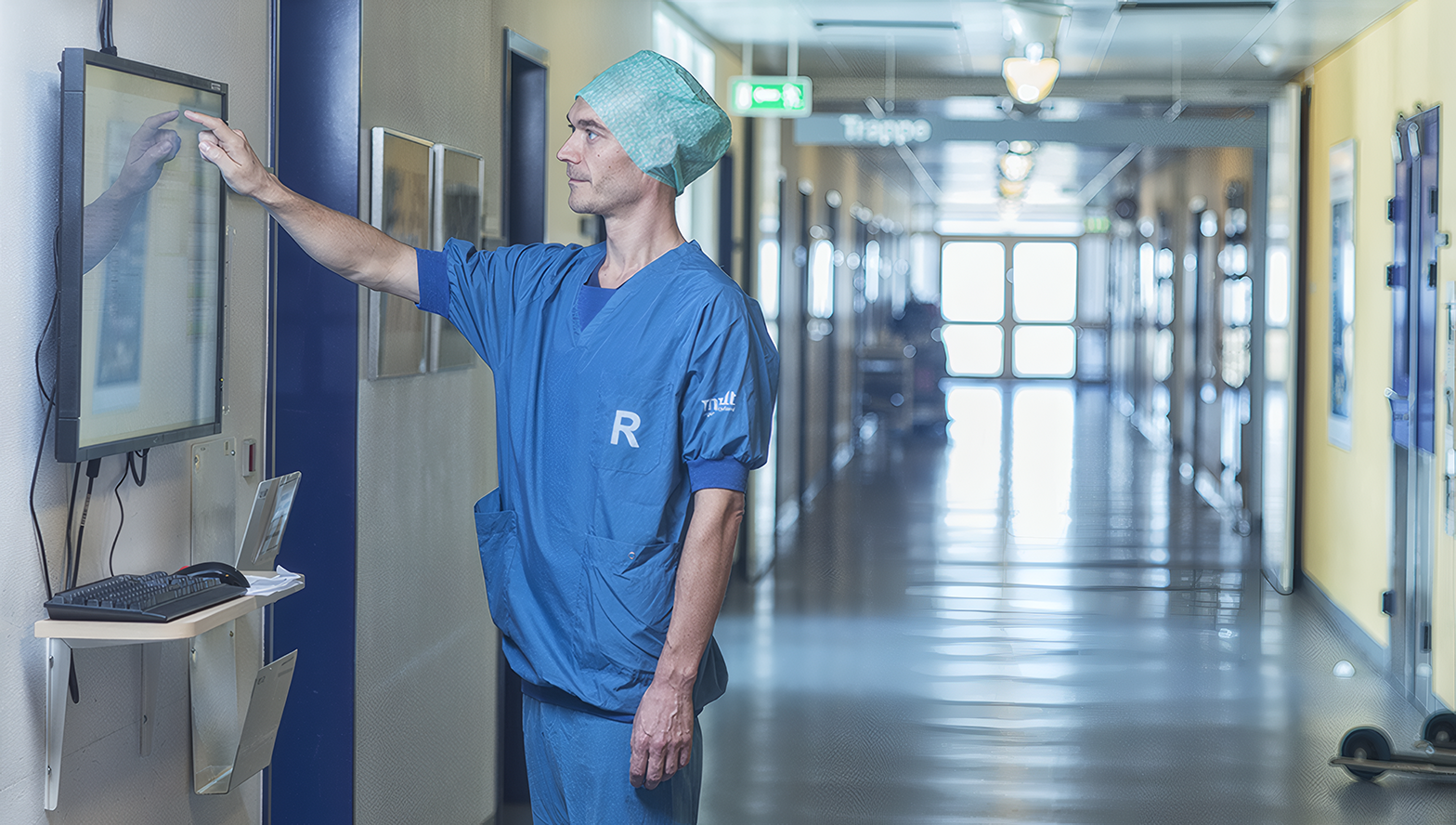
The information can be viewed on the department's logistics boards, which contain the entire department's capacity management: Who is at work, where the patients are located, which ward doctors are available, and which nurses and secretaries are on duty. The board displays a picture of each employee along with various information – and now you can also see where they are.
On the large 65-inch touchscreen, you can also type: 'Where is Pia?' if the screen doesn't immediately provide the answer. The information can also be accessed via a computer and the staff's smartphones, depending on the need.
In their daily work, doctors and nurses often use the logistics screens, while coordinators and secretaries work at a computer to find the information.
– It is a key task for us to get the localization messages out onto the platforms that the clinics are already using. The information must be easily accessible, intuitive, and available where the staff are, says Claus Bugge.
It is important for Claus Bugge to emphasize that information about where staff are located is not stored.
– The technology provides an opportunity for better support for the staff, not surveillance of them. Localization data for employees is only a live view of the here and now. When we put RFID tags on a ventilator or a trolley, we store the information so we can track if and where the equipment has been used. When it comes to staff, we are only allowed to show where this resource is right now. We are not permitted to store this information. That is how the system is designed. It distinguishes between technical equipment and people.
The future of staff localization
The development of new localization technology continues, which could mean that staff might potentially have access to too much information in the future. Here, knowledge of a person's location can be used to ensure that information reaches the right person at the right time, so that not all nurses are disturbed if, for example, a patient has fallen out of bed.
– We are working on making the information increasingly accessible and easier to use. For example, not everyone may know where room J 214 is, so you will also be able to see it on a map, says Claus Bugge.
The goal is to implement the technology in other departments at Aarhus University Hospital and at Gødstrup Regional Hospital near Herning, which already have the infrastructure but are not as far along in rolling out localization in the clinic. Claus Bugge and his colleagues are also in close communication with hospitals in Zealand and the new hospitals in Odense and Aalborg.
– We agree on using GS1 standards. And because we use open standards from GS1 and have open interfaces, it is just a matter of telling suppliers and innovation initiatives to tap into this information and use it to create value, says Claus Bugge.
The overall goal is to create value, not control. When we look at location technology in a broad sense, it should improve efficiency, support sustainability, and contribute to data-driven decision support. This should lead to better patient care, resource management, and process automation. And it is particularly the latter two that we can strengthen when we know where staff are located.
The chief physician has the final word:
The location system matters to me, it matters to those I work with – and it matters to the most important people of all, namely patients and their relatives. It is quite thought-provoking that when the system was down at one point, everyone complained about missing it. And that is probably because it is a good thing to have, says Peter Krogh Brynningsen.

We have been able to tell our software vendors: 'You must comply with these standards.' If we didn't have the standards, it would have been more chaotic, and our software vendors would likely have set the agenda to a greater extent. Now, we rely on a common language that GS1 has provided us.